|
Musicians
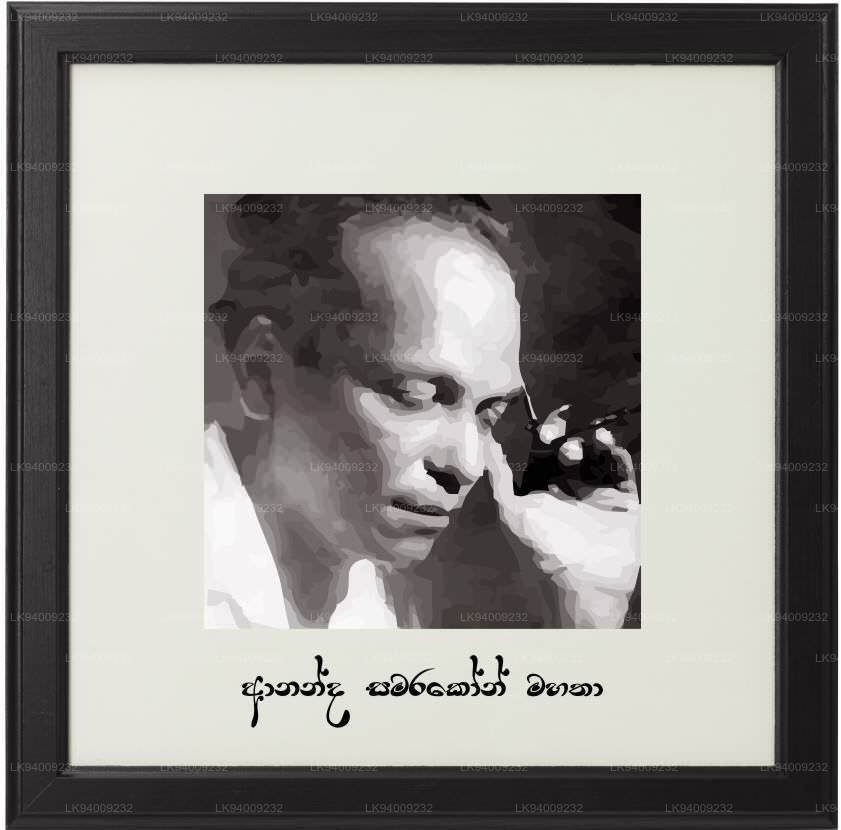
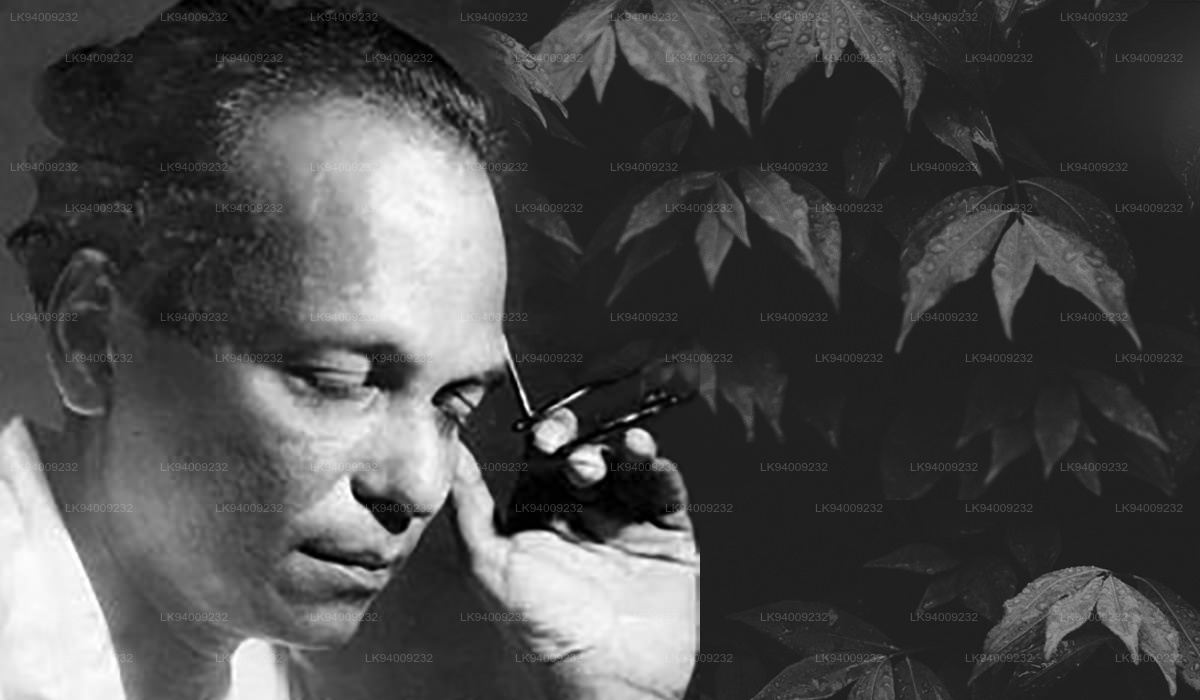
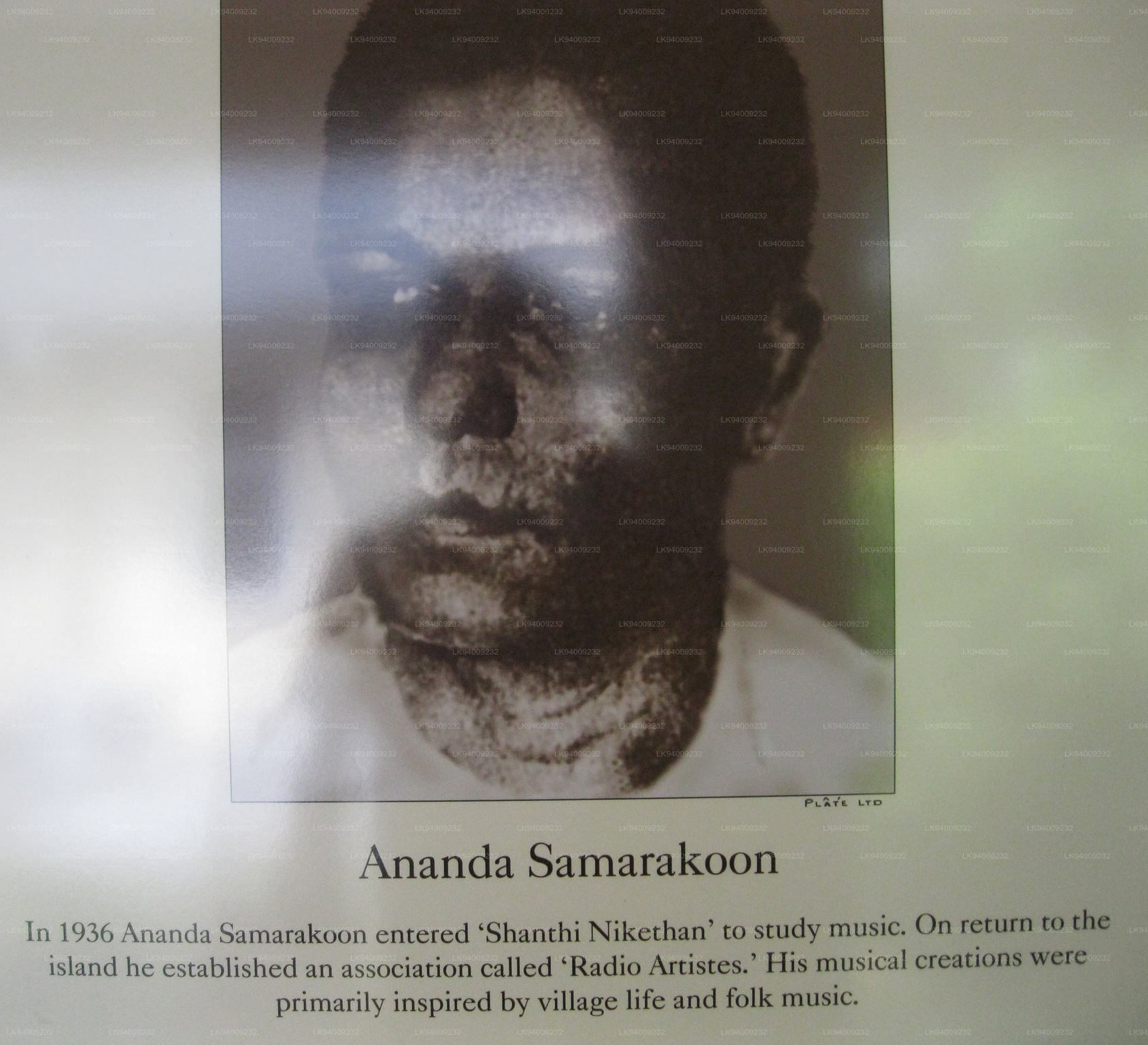
Ananda Samarakone

"Samarakoon is a timeless melody", wrote Chandraratne
Manavasinghe a few days after the musician's tragic death.
"His music brought freshness and sweetness to our weary
lives. His lyrics were an adornment to our language. Whilst
taking Sinhala music towards a new vista, he gave his fans
joy and happiness".
Born on 13 Jan 1911 to a Christian family, Samarakoon was
baptised as George Wilfred Alwis. In 1936, Samarakoon left
to Shantinikethan to study art.
Ananda Samarakoon created our national anthem. He is also
the father of the artistic Sinhala music. We may also consider
Samarakoon as the founder of the modern 'geeta sahitya".
Certainly he was the precursor to all consequent lyricists.
Manavasinghe admitted that it was Samarakoon's work that inspired
him to become a lyricist. We must also note that Samarakoon
was an exceptionally gifted painter.
Critics
rank Samarakoon with Sunil Santha and Amaradeva as the three
most influential figures in Sinhala music. Prior to Samarakoon
we had nothing that can be called as original Sinhala music.
No one perhaps ever felt the need to have one, or thought
it was possible to have a musical tradition of our own. In
this sense we may even consider Samarakoon as our musical
conscience. He studied music only as a secondary subject.
In six months he abandoned his studies and returned to Sri
Lanka. In 1937, he changed his name to Ananda and embraced
Buddhism. He was patently influenced by Ravindranath Tagore
of India. It is his fascination and the desire to emulate
the great Indian musician that took him in the direction of
creating a musical tradition of our own.
The
vogue at the time was Nurthi Drama, with songs derived from
the North Indian Ragadhari music. Lyrics of Nurthis songs
were often meaningless phrases with no or little literary
merit.
Samarakoon
was aware of the need to create a form of a symphony that
can be classified as our own. As Amaradeva described, Samarakoon
succeeded in creating a new consciousness, as he had realised
that the best way to touch the innermost point of sensitivity
of the people and evoke response from them was to identify
the music with the traditions of the land. For melodic patterns,
Samarakoon turned his attention to the Sinhala folk song,
a source totally ignored by all his predecessors. He also
followed the Tagorean dictum that in creating a song, the
musical composition and the lyrics must be of Equal importance.
In fact, the lyrics and the tune should be inseparable. his
intimate knowledge of the village and its landscape, its people,
their culture, values and beliefs, was the source from which
Samarakoon drew material for his lyrics. He was careful in
his choice of the musical instruments. He also used a carefully
cultivated vocal technique to give the Sinhala feeling in
his renderings.
It
is the immortal classic "Endada Menike" (1940) that
paved the foundation for the artistic Sinhala music. The duet
unfolds in the form of a dialogue between a young village
boy and a girl. Its theme is love. Yet the song contains no
single direct reference to love. Its child-like quality is
characteristically Samarakoon at his best. "Endada Menike"
is a tryst with Goddess Sarasvati. Disguised as a village
maiden, Sarasvati is picking Kekatiya flowers from a brook.
On
the bank is her lover (admirer), the village youth with a
flute.(Samarakoon later drew a painting to illustrate the
tryst). In love with the damsel, the boy is eager to join
her in the frolic. She innocently dismisses his advances,
teasing him that she would change form and drift away from
him. Culmination of this song is her claim that she is illusive
and that she would turn into a form invisible. However, the
boy has the ultimate device to ensnare her and keep her in
captivity. It is the sweet melody of his music from which
she could never flee away. The language is poetic and beautifully
rustic. Just like most of his successful compositions, in
"Endada Menike" the poet and the musician are combined
and are inseparable. Critics and fans were equally enthusiastic.
Inspired by this success Samarakoon went on to create a string
of successful songs in the early to mid 1940s, the period
regarded as his golden era. Among his best known works are:
"Podimal Etano", "Vilay Malak Pipila",
"Poson Pohoda", "Asay madura" "Sunila
Guvanay", "Punchi Suda", "nilvala Gangay",
Sumano", "Pudamu Kusum", and "Siri Saru
Saara Ketay".
In
1945 Samarakoon's only son died tragically at the age of five.
Crushed by this grief, Samarakoon left the country. He roamed
in India between 1947-1951, a period during which he probably
did not compose any songs. He returned to his first love,
painting and held eleven art exhibitions in India., Malaysia
and Singapore. His work as a painter drew high critical acclaim.
His illustration for the song "Endada Menike" drew
the following remark from his contemporary Sunil Santha: "I
would not venture into the task of discerning whether Samarakoon
was born as a musician or a painter!"
In
1948, in his absence, one of his early compositions, "Namo
Namo Mata" (composed in 1940, recorded in 1946) was nominated
as the national anthem and was officially adopted by the State
as the national anthem in 1952. During the last ten years
of his life (1951-1962), we witness a gradual decline in the
artistry of his compositions. His association with the film
industry as a lyricist and dialogue writer also did not yield
any thing of substantial artistic merit. It was a fiasco in
many ways. The fame of being the creator of the national anthem
became a bane. Critics were now savage on its lyrics, more
particularly the "Gana" significance of the introductory
words (Namo Namo Matha) which designate disease and ill luck.
Samarakoon was not a believer in "Gana", and the
criticism must have caused great pain to him. He wrote numerous
articles counter attacking his critics in a naive and unlikely
attempt to defend his composition. Without his consent, the
introductory words were changed to "Sri Lanka Mathaa"
so that the "Gana" significance now would designate
victory and prosperity.
Samarakoon
reacted strongly to this move and the manner in which it was
done. Samarakoon had once vowed that he would rather sacrifice
his life than allowing changes to the lyrics of his composition.
On 5 April 1962, Samarakoon committed suicide by taking an
over-dose of sleeping tablets. He was fifty-one at the time
of his death. Samarakoon's contribution in musical education
is worthy of mention. RA Chandrasena, the man instrumental
in introducing Victor Ratnayaka and Premasiri khemadasa studied
music under Samarakon in early 40s. Pandit Amaradeva (W. D.
Albert Perera) studied music under Samarakoon in late forties,
and also worked as his understudy. Some of Amaradeva's early
compositions were based on Samarakoon's lyrics.
Some
early compositions of both Sunil and Amaradeva discern Samarakoon's
style. Listening to the original renderings of "Endada
Menike", "Vilay malak Pipila", "podimal
Etano", "Poson Pohoda" etc away from your motherland
is an unique and an unforgettable experience. Samarakoon the
timeless melody was also a prophet!
Pandith
Amaradeva

Pandit
Amaradeva's contribution to the music scene in Sri Lanka is
more than a period of five decades has been an incomparable
one. His music has been the most influential force in forging
what could be called a truly Sri Lankan music with a unique
national character and identity. At a time in the past when
Sinhala music was at a downfall, his music provided the necessary
direction and infused it with a fresh vigour. From that time
onwards his musical creations have captured the hearts of
several generations of music lovers, both young and old. Perhaps
his greatness lies in his ability to create a range of emotions
in the listener with that richly expressive voice of his which
immediately 'transports' the listener to a world of his own.
Pandit Amaradeva's repertoire of musical compositions displays
an astonishing variety. This son of the soil is truly a gift
of the gods to the nation and there would not be another in
his category of music.
Nanda
Malini

Nanda
Malani the most acclaimed lady singer of Sri Lanka and by
critical assessment, the one who represents best the genius
of the Sinhalese. The rich timbre of her voice, it’s
poignancy and expressiveness, and it’s characteristically
Sinhala intonation all combine to make her singing an unique
experience to the listener. Trained at "Bhatkande Sangeetha
Vidyapita", Lucknow, and grounded in the theory and practice
of classical Indian music, she is equally at home in the sophisticated
melodic and rhythmic patterns of Raga music as in the simple
compositions of the Sinhala tradition from which she first
drew her inspiration.
Numerous prestigious awards have brought Nanda Malani in to
National recognition.
In
1963 she was adjudged the best singer at the Sarasavi film
festival. Since then she has won awards almost every year.
She was invited to Singapore, Malaysia, Pakistan, Germany,
The Soviet Union, United kingdom, Italy, and France, Middle-east
countries and Maldives countries where she gave very successful
concerts.
In
her personal life Nanda Malani embodies the ideals of Sinhalese
womanhood. Very simply dressed but elegantly mostly in white
Nanda Malani is modest while being dignified.
|